
I stared at my computer screen in surprise:
"The Ethiopian Wildlife Conservation Authority has just contacted Ethiopian Rift Valley Safaris regarding some problem lions around the town of Metahara that borders Awash National Park in the Danakil Region. Historically, the lions around Awash National Park have been notorious man- and cattle-killers, and during the last two weeks some lions have been reported to have been killing people, livestock and camels. A hunt has to be urgently scheduled to try and resolve this problem as soon as possible. The professional hunter who will guide the hunt will be Jason Roussos, who will decide at the time how many problem lions are involved and how many need to be harvested to eliminate the problem."
Good grief! Could this be? I immediately thought of the famous Colonel Patterson and the fabled man-eating lions of Tsavo, but that was a century ago. Man-eaters in 2008?
On the other hand, I had hunted twice with Jason Roussos with great success,
and I knew that he was absolutely top-notch. To see if I could find further
information, I started searching the Internet on various topics and found a
Reuters newscast:
Lion Kills Ethiopian After Straying From
Park
Addis Ababa, Sept. 21 (Reuters)--A lion ate a local man in eastern
Ethiopia after escaping from a game park, police said on Sunday. Staff of the
Metahara sugar factory ventured into a nearby cane plantation last week to
search for a missing worker. "They came upon a lion, and the field was soaked
with blood," a police spokesman Commander Demsash Hailu told Reuters. "The lion
escaped, but they found the missing man's head." He said they suspected the big
cat had strayed from the Awash Game Park, some 225 Km (140 miles) east of the
capital Addis Ababa.
Ethiopia's symbol is the rare black-maned lion, which is on their currency and often depicted in statues. I knew that Awash National Park was pretty good-size--certainly not a game park in any normal sense--and looking on the map, it seemed likely that lions could move out of the park and into the 100-plus-square-kilometer Metahara sugar cane plantation, home to some 35,000 workers, staff and dependants.
I turned to my wife, Pam, and said, "I'm going to try for this," to which she sweetly replied, "Not without me." I emailed Ethiopian Rift Valley Safaris, and being the first to respond, we found ourselves returning to Ethiopia.
This was September 24th, and Jason wanted us in Addis Ababa by October 4th. We spent the next 10 days getting .416 Rigby softpoints, checking zeros, getting shots and anti-malaria pills, making airline reservations and arranging for the endless variety of prehunt considerations.
During this period, Jason provided additional information to us via email. It was obvious that this was going to be different from any normal lion hunt.
Crucially, Jason advised us that the man-eaters we sought had been seen and were a huge female accompanied by a three-quarter-grown cub. Another female was occasionally seen accompanying them. A male was in the area, but he came and went unpredictably.
All of this flashed through my mind as the Boeing 777 touched down at Addis Ababa.
Jason greeted us and took us to a fine hotel. The next morning we drove through the unbelievable chaos of bustling Addis traffic and drove some four hours south and east to our destination.
Entering the Metahara Sugar Plantation premises, we were surprised when we turned into a small park surrounded by homes in the main sugar factory worker's compound. Jason explained that it was close to where the lions had been active, had access to good water and had shade trees (Metahara is sweltering at midday). Tents had been set up in whatever shade was available, and we quickly settled in.
As sunset wasn't until 6 p.m. or so, we took rifles and went to check zeroes. I was taken aback to see that the sugar cane was in thick, dense, impenetrable blocks of vibrant green as far as the eye could see. Sugar cane has a narrow base, but then bushes out, creating low tunnels close to the ground, ideal concealed runways for warthogs, bushbuck, hyena and, obviously, lions. Not only was the eight-foot-tall cover unbelievably thick, the area was also crisscrossed with six-foot-wide irrigation canals paralleling the access roads, which a lion could easily jump, but which presented further obstacles to us. Long rows of stately acacia and flame trees lined the access roads, further limiting a clear view and field of fire. To top it all off, there were goats, cattle, young herders and pedestrians along nearly every road. This was clearly both a paradise and a prey-rich environment for the lions.
Jason further improved on my afternoon by telling me that, in fact, there had been problem lions hunted on a nearby plantation several years earlier. A Zimbabwe PH and his client had gotten badly hammered after following a wounded lion into the sugar cane and needed an emergency medivac.
My .416 Rigby, however, checked out beautifully. One of my shots was one inch high, and the other hit the center of the X-ring. (Always zero dead-on for dangerous game--you'll probably be shooting fairly close, and zeroing high can get you into trouble.)
We then drove over and visited the sight of the most recent kill. The man had been fully eaten except for his skull, and there was little to see after two weeks. The guards and workers were, however, still scared silly, and rightly so, as one showed us massive scars from a lion mauling. It also turned out that there had been another killing six months earlier, and two other workers were reportedly still in hospitals with mauling injuries.
We spent the first afternoon cruising with our guides, getting some idea of the enormous sugar cane fields, their relationship to major access roads and the adjacent lake area. One of our first discoveries was a large set of fresh lion tracks going through a nearby workers compound--within five feet of the front and rear doors of the workers' shacks. Small children were everywhere, playing innocently where a lion had walked hours earlier.
The common method of hunting lions is baiting, and given the impenetrable cover, we were planning to place a bunch of baits to draw the lions out to where we could safely get a shot. We were perfectly delighted to spot two Ethiopians beating the bejeezus out of a cow that lay in the road, exhausted.
We braked, backed up and told the two kindly fellows that we would like to buy their fine cow for bait (we had a special permit for this). The Ethiopians perked right up and named a price only five times the going rate. After a lot of haggling we got the cow for $100, killed it, halved it and threw it in the truck--two baits (and a lot of good, juicy cow guts for dragging).
We had three warthog tags for bait as well. Down by the lake, from the warren of ground-level tunnels in the cane, warthogs issued out to graze peacefully in the afternoon. Going down one of the lakeside access roads, we saw three warthogs grubbing in the short grass. We shot a nice boar at 130 yards with a .416 on the shoulder. Amazingly, the boar flopped about, then got up and bolted into the cane. Now, the boar died, but the bad news was that Jason had to go into the cane to get it. We couldn't allow this with a lion, but obviously even a well-hit animal could dive 10 yards or so into dense cover.
We hung three baits at sites that were well away from any habitation, allowing a field of fire. The baits were high enough off the ground that the lions couldn't get all of the bait in one go. Additionally, we concealed the baits from vultures and the like and proceeded to drag the cow entrails down the roads leading to the baits.
For an added boost, Jason had varmint-calling speakers and tapes of male lions. The hope was to either attract a male defending his territory from an artificial interloper or, second, perhaps some love-struck female lions.
We began a grueling regimen of nighttime hunts, usually from 5:00 p.m. until 11:00, then back out from 4 a.m. till seven or eight, catching up on our sleep during the sweltering daytime. These efforts entailed talking with workers about any sightings, checking around the baits, calling with the varmint calls and endlessly spotlighting, essentially searching for red eyes glaring back.
Our nighttime drives revealed East Africa's rich game population. Nightjars and owls were everywhere, as were bushbuck, civet cats, jackals, hares and an occasional glowing serval cat caught in the spotlight. Since this was a special-purpose hunt, I could only look wistfully at these, as we had tags for lion and warthog only.
We spotlighted umpteen bushbuck and civet each night, but no lions. Nothing had come to our baits to feed, although Jason almost stumbled on a lion late one afternoon that had been near a bait. Jason looked a bit shaken, but the lion dove into the cane in a tawny flash--a disturbing sign.
We began to develop a very strong suspicion that the locals must have been poisoning the lions, as the lions were avoiding our succulent, stinky baits. Lions are smart--lions where poisoning has been attempted will not come to baits or even revisit their own kills for a second night.
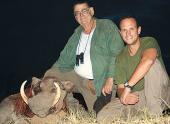
Our third night began with shooting a monster 14-inch warthog at about 6 p.m. We put him in the back of the truck and continued cruising to the area where the killing had occurred previously. Since we couldn't lure the lions out with baits, we had to go where they had last been sighted.
We neared the site, rattling along through clouds of moths and throwing up a fine rooster-tail of dust behind the truck, when Jason flicked his spotlight down a side road--eyes glared back.
Jason yelled, the truck turned into the side road, and we turned to face the points of intense light. I was told to get ready. Looking through the scope, I saw the lion. Jason informed me it was a young female and to wait. I couldn't see it through the scope, but Jason could see a second lion as well, lying down. It was a huge female.
The lions were on a low ridge to our left front. We had to anchor the lions before they reached the cane field.
The lions were less than two miles from the September kill site and almost exactly at the location of the kill six months earlier. They also fit the description. The game scout said he felt certain that these were the two he had seen at the recent kill.
Jason got his rifle and told me to be sure of my shot. I got a clear 120-yard sight picture of the young lion facing to the right, looking back into the lights. I put the glowing crosshairs on the shoulder, hoping to immobilize the lion.
Jason gave me the go-ahead to shoot, but just as I shot, the cub turned away. The muzzle brake on my .416 created a blinding cloud of dust, and I lost my sight picture. Jason fired, but the billowing dust also prevented a clear shot for him. We could vaguely see the lions heading toward the irrigation canal and cover.
We reversed the truck, driving frantically back to the main road, then down an irrigation canal. In front of us, a lion had jumped over the canal and paused for a moment. The truck stopped, and I hammered the big female, dropping her on the spot.
A moment later the smaller lion showed herself--heading for the safety of the cane. Just as she reached the cane, I had a really decent sight picture and hit her very hard, just behind the shoulder. Nevertheless, she entered the cane.
Jason got down and approached the big female. She had dropped in her tracks--quite unusual. You normally need to spine or brain an animal to do this. However, she never moved, and I was intensely grateful.
I covered Jason as he approached the cane field, looking for the young female. Blood was in heavy gouts, but we decided to wait for morning, hoping the lion would bleed out during the night.
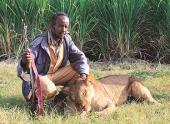
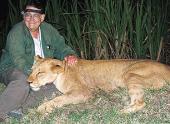
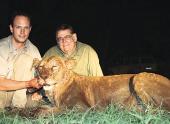
The camp was jubilant with our arrival and the monster lioness, weighing roughly 350 pounds. To the throng of natives the lion was a lurking, latent threat to family and friends, a near-mythical bringer of death or horrible injury. With a skull approaching 20 inches, the great jaws were truly fearsome.
At 7:00 a.m. we were back to find the young female lion. Jason asked me not to go into the cane; it was just too dangerous. We reviewed pressure-bandage and first-aid procedures, just in case.
Jason and another P.H., Tshome, slid into the cane tunnels, trailing a green rope, in order to find them quickly in the matted cane. Jason carried a 12 gauge and Tshome a .375. Several minutes passed, and the rope slowly paid out behind them into the cane. Then a radio broke the suspense. They had found the young lioness about 40 yards inside the cane, dead. We all heaved a long, drawn-out sigh of relief.
The young female weighed roughly 300 pounds--a formidable predator. Examining the lion, we found the first shot the night before had creased the neck, causing no serious damage. The second shot entered on the shoulder, took out the lungs and heart, and exited just behind the offside shoulder.
We hunted the next four days for a male lion, but despite calling and searching widely, we saw nothing. We did take a break one morning to go to an adjacent area, where Jason had a tag and collected a lovely little Salt's dik-dik.
The last night, we were still searching for a male when Tshome's cell phone rang. It was a report of another lion, back over where we had shot the others four days earlier.
We drove back to the area and initially failed to spot the lion. Then a big female going down a dry irrigation ditch and showing nothing but her shoulders and the top of her head was spotted. She came to the end of the irrigation channel and jumped into full view, a beautiful sight in the circle of the spotlight. We had no interest in another female and drove past her as she lay down on the irrigation canal brim.
We hadn't gone more 300 yards when she began to call. She penetrated the night for 15 minutes with great roars ending in coughs. We parked and waited, hoping that a male lion might respond to the calls--no response.
Jason became curious, so we drove back past the lion (still roaring) to a guardhouse. The guards advised Jason that the lioness had been in the area for three nights, roaring. That meant that she began to call the evening after we shot the other two--a striking coincidence. Was she missing her companions? The guards had seen this big lioness on the plantation for three days, and she seemed to show no fear of man.
Why was the lioness alone? Lions are the most gregarious of creatures--a lone female is unusual. Then there was the fact that a third lioness was known to associate with the two man-eaters… Finally, she was less than two miles from the last kill and about one mile from where the other lions had been shot--not very far. A dark suspicion began to form in my mind. We cruised for 10 or 15 minutes. I could tell that Jason was considering the same points I was pondering.
Whether it was helpful or not, I told him that he would be taking an inordinate risk by leaving this lion. Even if our several concerns were circumstantial, what would happen if someone was killed in one, two or even six months? Even if this lion wasn't involved, all lionesses look reasonably similar, and undoubtedly he would be accused, justifiably or not. He could never know for sure.
Jason and Tshome decided to consult with the Game Department in Addis, even though it was 9:30 at night. Ten minutes later the Game Department phoned back with a death sentence for the lioness--no one could take the risk of letting her go.
We drove back, and she hadn't moved. Her location was not good. If wounded, she could dive forward into a dry irrigation ditch and escape either way to cover. If she fell backward, she dropped from view 10 feet into a sugar cane field that stretched for miles.
I asked Jason to back me, as we did not want an incident. I took very careful aim and fired, with Jason's rifle going off a split-second later. It was all over in a fraction of a second.
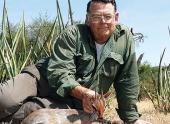
Upon examining the lioness, we discovered that she had very bad teeth, was weakened and probably dependent upon others for food--a very high potential to become a problem lion, if she wasn't already. The decision to take her had been the correct one.
Breaking camp, we were comfortable with the belief that we had dispatched the two man-eaters. Short of DNA analysis of the colon contents (which was problematic after nearly three weeks and unavailable in any case), everything else pointed quite strongly that we had the right lions. The third lioness was clearly a high-risk animal and had probably partaken of the other lion's kills.
The hunt was clearly a success, but someone who loves Africa cannot help but have a certain bittersweet sense of loss. Lions have ruled the African night for eons, and now they are under ever-increasing pressures from an ever-expanding human population. When the lions are reduced to small, fenced enclaves, something magical and elemental will have disappeared from the African night.
Contact: Ethiopian Rift Valley Safaris, (618) 966-3563; ervs@shawneelink.net
| PRINTED FROM HUNTINGMAG.COM | COPYRIGHT © 2009 INTERMEDIA OUTDOORS |